❄️ Fort Wayne, Indiana · Winter Safety Guide · 2026
Winter Driving Tips for Fort Wayne, Indiana — What Actually Helps
33 inches of snow a year. Three river bridges that ice before the roads around them. I-469 construction zones that create new hazards every season. Fort Wayne winter driving has specific challenges that generic advice doesn’t cover.
Fort Wayne winter driving — the local specifics
Allen County’s winter conditions are shaped by its geography: the confluence of the St. Marys, St. Joseph, and Maumee Rivers creates localized weather patterns. River corridors stay colder longer and develop ice conditions before surrounding areas. The open farmland stretches on US-24 east and west of the city allow wind to drift snow across roads faster than urban areas.
The result is a city where conditions vary significantly by location and time of day. A commute that takes 20 minutes in October can take 50 minutes after a January storm — not just because of snow accumulation, but because specific chokepoints (bridge crossings, I-469 on-ramps, US-30 intersections) become especially dangerous.
Before winter: what to check on your vehicle
| Item to check | Why it matters in Fort Wayne winter | When to check |
|---|---|---|
| Battery (load test) | Batteries at 70%+ health in October can fail to start engines below 10°F — common in January | October, before temperatures drop |
| Tire pressure | Pressure drops ~1 PSI for every 10°F temperature drop — underinflated tires lose traction | Every 2-3 weeks in winter |
| Tire tread depth | Worn tires lose grip on snow and ice dramatically faster than tires with adequate tread | October |
| Antifreeze/coolant mix | Incorrect mix freezes at temperatures Fort Wayne regularly reaches in January | Fall service |
| Wiper blades | Standard blades accumulate ice — winter blades with rubber enclosures work better | November |
| Brake condition | Brakes that are marginal in normal conditions become genuinely dangerous on ice | Fall service |
A pre-winter check isn’t paranoia — it’s the difference between a winter that costs nothing and one that costs a service call, a battery replacement, and a tow to a shop on the coldest morning of the year.
Fort Wayne road-by-road winter risk guide
🔴 Highest winter risk
- St. Marys, St. Joseph, Maumee River bridge decks — ice before surrounding roads
- SR-14 (Waynedale area) — known early-ice stretch, early morning especially
- I-469/US-24 interchange — complex merges, highway speed, frequent accidents
- Open US-24 east of Fort Wayne toward Woodburn — drifting snow, no wind breaks
🟡 Elevated winter risk
- I-69 north toward Huntertown — open stretches, drifting conditions
- County roads around Grabill, Leo-Cedarville — low plowing priority
- US-30 west toward Columbia City — commercial traffic, limited lighting
- SR-930 between Fort Wayne and New Haven — industrial traffic, bridge at St. Marys
What to do if you get stuck or slide off the road
The instinct when stuck in snow or ice is to press the accelerator. That’s the wrong move — it spins the tires and packs the snow beneath them into ice, making the situation worse.
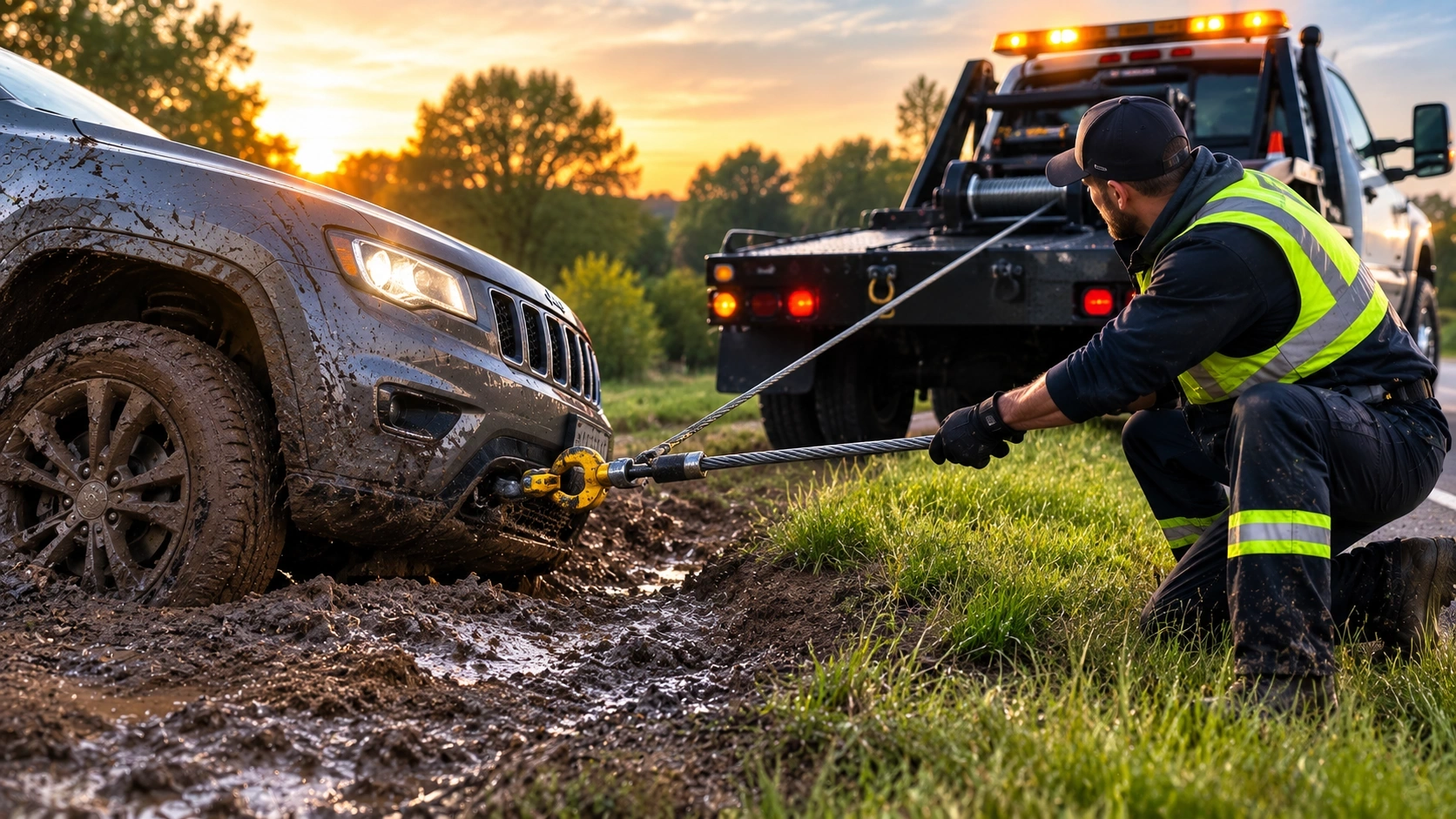
For snow stuck: clear snow from around the drive wheels if possible. Try rocking the car gently — short forward and reverse movements with minimal throttle. If you have sand or cat litter, spread it under the drive tires. If these don’t work within 3-4 attempts, stop — you’re digging deeper, not gaining traction. Call (260) 279-6688 for a winch-out.
For a slide-off into a ditch: don’t try to drive out. Once a vehicle is at an angle in a soft shoulder or ditch, applying power usually worsens the position. Hazard lights on, stay in the vehicle if near traffic, and call us. A controlled winch-out by a TROCP-certified driver recovers the vehicle correctly without causing secondary damage.
Fort Wayne winter driving — answered
Modern fuel-injected engines don’t need extended warm-up times — they reach operating temperature faster by driving gently than by idling. A 30-60 second idle is enough to allow oil to circulate before putting load on the engine. Fort Wayne city ordinances in some neighborhoods also limit idling time. If warming up is about comfort (defrost, cabin heat), the car heats faster while driving.
For drivers who commute on I-69, I-469, or rural county routes regularly, winter tires provide a measurable safety improvement over all-season tires in temperatures consistently below 45°F — which Fort Wayne sees from November through March. Winter tires’ rubber compound stays pliable in cold where all-season compounds harden, improving grip on dry cold pavement, snow, and ice. The investment is roughly $400-$800 for a set plus installation.
Two main causes: the battery doesn’t deliver enough cold cranking amps at low temperatures (the most common reason), or the engine oil has thickened from the cold, making it harder to turn over. If the engine cranks slowly before starting or doesn’t start at all, the battery is the first thing to check. If the battery tests fine, the oil viscosity and engine condition are the next suspects. A load test at any auto parts store confirms battery health in minutes.
On ice, stopping distances can be 10 times longer than on dry pavement. The standard 3-second following distance for normal conditions should extend to 8-10 seconds on snow or ice. On I-69 or I-469 in winter conditions, give yourself much more room than feels comfortable — especially approaching bridges (St. Marys, St. Joseph, Maumee) where ice forms first.
Winter breakdown in Fort Wayne? We're on it.
24-hour dispatch including during snowstorms. Jump starts, winch-outs, flat tires, and full tows — whatever Fort Wayne winter throws at you.