What to Do After Your Semi Jackknifes
Your trailer swung out and folded against the cab — or worse, it’s sitting sideways across a lane. Short version: get yourself safe first, secure the scene, call for help, and don’t try to drive out of it. Below is each step in order, what to tell the people you’re calling, and what the recovery will look like. Our heavy recovery crews run 24 hours — a 2 a.m. jackknife on I-469 gets the same response as a midday one.
What should you do in the first five minutes after a jackknife?
Your first job is staying alive, not saving the load. Hazards on, parking brake set, engine off if you smell fuel or see leaking fluids. Get triangles or flares out — one behind the truck, one well back on a fast road. Then get yourself and everyone else clear of the travel lanes and stay there.
If the rig blocks traffic, someone is hurt, or there’s a spill, call 911 before anyone else — dispatch and the tow company can wait two minutes.
Should you try to straighten the trailer and drive out yourself?
No — this is where drivers get hurt or turn a bad day into a totaled rig. A jackknifed combination is under huge, unpredictable tension: pulling forward can snap the trailer around, roll it, or drag it into live traffic. If it’s blocking a lane, off the shoulder, leaning, or anything feels wrong, park it and call for recovery.
A tow bill is cheaper than a rollover. Only ease it straight yourself if the trailer is upright, the road is clear, and you know exactly what you’re doing.
What should you tell your dispatcher?
Call dispatch once the scene is secure — they need facts, not the story. Give them: exact location (highway, direction, nearest mile marker or exit), whether anyone is hurt and if police or fire are coming, whether you’re blocking travel lanes, and whether the trailer is loaded or empty.
Photograph the truck, trailer position, road surface, and damage before anything moves. Those photos protect you if the carrier or insurer asks questions later.
What do you tell the towing company when you call?
The tow dispatcher wants to send the right truck the first time: highway and mile marker or nearest exit, direction of travel, loaded or empty (and roughly how heavy), where the trailer sits (shoulder, ditch, across lanes, upright or leaning), and road conditions (ice, snow, mud, dry).
Ask for the full price before the truck rolls — hook-up, hourly or per-mile rate, plus recovery charges. No quote? Call someone else.
What does a jackknife recovery actually involve?
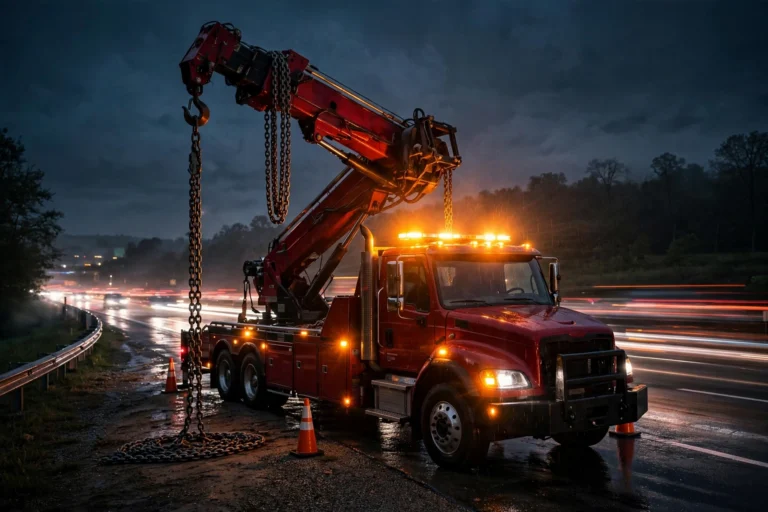
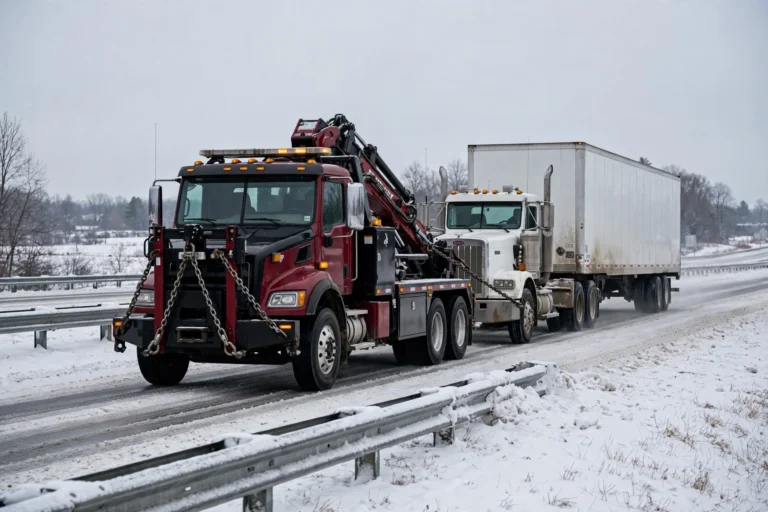
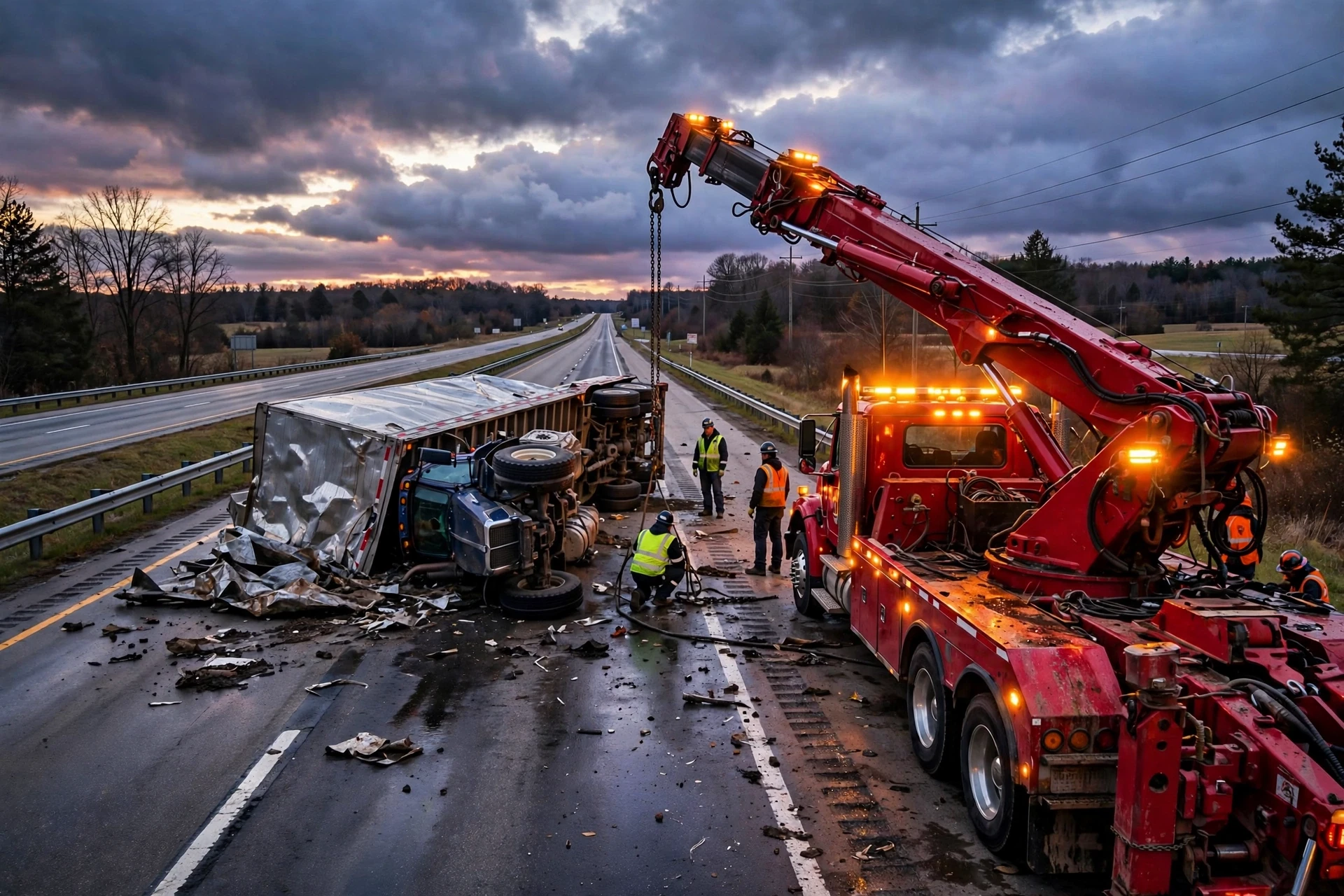
Still on pavement and upright? A heavy wrecker can often winch it straight and tow the combination out. In a ditch, leaning hard, or on its side? That’s a full recovery — usually a rotator (a wrecker with a rotating boom that lifts and swings massive loads) plus multi-winch setups to bring the trailer upright without tearing it apart.
The crew checks the fifth wheel, landing gear, air lines, and tires before anything moves. On cost: operator-reported 2026 ranges put a jackknife recovery plus tow around $1,500–$4,000+ — simple winch-outs run less, rollovers more. Your exact number comes from the dispatcher before the truck rolls. See accident towing in Fort Wayne.
How do you handle the paperwork and the load?
Document while you wait. Photograph everything: the overall scene, the trailer’s position, the tractor, the cargo area, the road surface, and any damage. Note the time, the weather, and what the road felt like.
If the trailer is loaded, check whether the freight shifted — the recovery crew needs to know, since a shifted load can make the trailer unsafe to tow. Keep every receipt and the itemized invoice; reimbursement runs on paperwork.
Why do most jackknifes happen in winter?
Black ice is the number one cause. The drive tires lose grip under braking, the trailer keeps its momentum, and around it comes. It hits bridges and overpasses first (they freeze before the road does), shaded curves, and anywhere meltwater refroze overnight.
Empty or lightly loaded trailers are the worst: less weight on the trailer axles means less grip, and crosswind can start the swing before you touch the brakes. If the forecast says freezing rain, treat every bridge deck as guilty until proven innocent.
How do you keep it from happening again?
Slow down before you need to — most jackknifes start with too much speed for the conditions, not bad luck. On ice, brake early and gently; stabbing the brakes is what breaks the trailer loose. Keep more following distance than feels necessary, and stay off cruise control on wet or icy roads.
With an empty trailer in wind, drop your speed and keep both hands on the wheel — gusts hit box trailers like sails. And check your equipment: worn drive tires and out-of-adjustment brakes turn a slick road into a guaranteed problem.
Frequently asked questions
Usually, if the carrier has the right coverage. Most carriers carry policies covering accident recovery and towing, but they have caps, deductibles, and fine print. Owner-operators should check their own policy before they need it. Keep the itemized invoice and your photos — claims live or die on documentation.
A simple straighten-and-tow takes under an hour once the wrecker arrives. A ditch extraction or rollover with a rotator often takes two to four hours on scene, longer in bad weather. Ask the dispatcher for a realistic window — and remember the clock usually runs port to port, so travel time counts too.
Sometimes, but don’t assume it. The crew must check the fifth wheel, landing gear, air lines, brake chambers, tires, and trailer frame first. A bent landing gear or cracked air line can make the combination unsafe even if it looks straight. If anything is damaged, it gets towed.
Almost always the carrier — it’s their truck and their freight. The driver should still call dispatch before authorizing anything expensive, since the carrier may have a preferred provider or a coverage cap. Owner-operators are the exception: without their own towing coverage, the bill lands on them.
A jackknife means the trailer folded against the tractor but stayed upright — recovery is mostly straightening and stabilizing. A rollover means the trailer or rig went onto its side, needing a rotator to lift it upright without destroying the trailer or spilling cargo. Rollovers take longer, need bigger equipment, and cost more.
Jackknifed right now?
Don’t try to drive out of it. Get safe, secure the scene, and call someone with the right equipment. 24/7 heavy dispatch.
More on our recovery equipment: heavy duty towing · heavy winch-outs