h
How Much Does It Cost to Tow a Semi Truck?
A short local semi tow typically runs $300–$800: a hook-up fee around $150 plus $6–$7 per mile in tow. Loaded rigs and long hauls climb to $8–$12+ per mile. Your exact number depends on weight, distance, and what went wrong — but any straight company quotes it flat before the wrecker rolls. Our heavy dispatch runs 24 hours, so that flat quote is the same at 2 a.m. as at noon.
How do semi towing companies charge — by the mile or by the hour?
Both. Per-mile pricing is a hook-up fee (around $150) plus $6–$7 for every loaded mile. Hourly pricing runs $175–$250 per hour port to port — the clock starts when the wrecker leaves its yard and stops when it’s back, round trip included.
What’s a typical hook-up (base) fee for a semi?
Expect roughly $150 to get the heavy wrecker to you and hooked up. That covers dispatch, travel to your location, and the first part of the work — positioning, rigging the under-reach, caging the air brakes, and securing the combination. After that, the per-mile or hourly rate takes over, which is why the base fee is a big share of any short tow.
Why does towing a semi cost so much more than towing a car?
It’s the equipment and the readiness behind it. A 50-ton heavy wrecker costs around $475,000 before tools, and the company still has to keep trained operators on call 24/7. A car tow needs one light truck and ten minutes of rigging; a semi needs a six-figure machine, a two-person crew, and real knowledge of air brakes, fifth wheels, and loaded trailers. You’re paying for all of that to exist at 2 a.m. on an empty interstate.
What can push a semi tow bill higher?
Several things can:
- Weight — an 80,000-lb GVWR loaded trailer costs more to move than an empty bobtail.
- Winch-outs — stuck in soft ground or a snowy lot? A basic heavy winch-out runs about $500 for under an hour on scene; complicated ones climb fast.
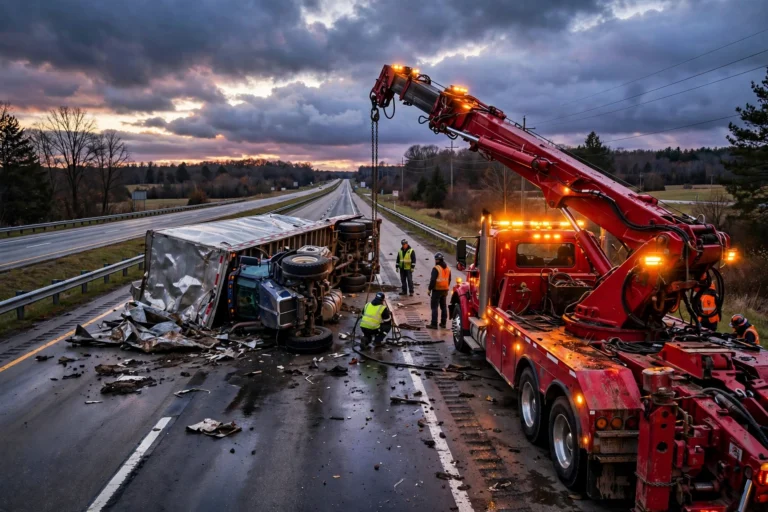
- Recovery work — jackknifes and rollovers need rotators and multi-winch setups, billed separately from the tow itself.
- After-hours — nights, weekends, and holidays carry a surcharge with most operators.
- Waiting time — standing by during cargo transfers or police paperwork is billable time.
- Load issues — shifted freight that has to be repositioned roadside before the truck can legally move.
Do winter conditions change the price?
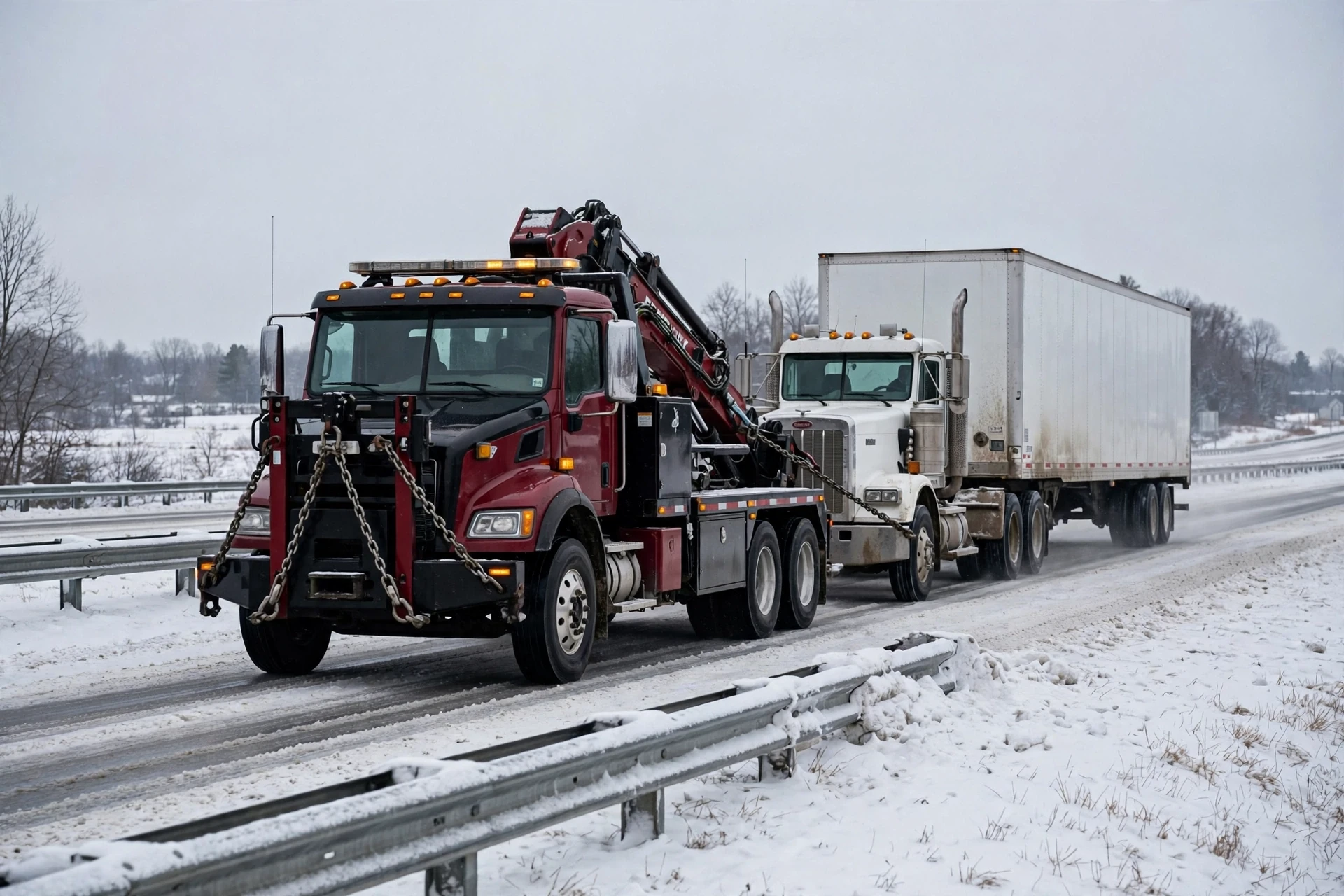
They can. When ice and snow hit, call volume spikes and every recovery takes longer — a jackknifed trailer in a whiteout is not a quick hook-and-go. Some operators add a winter or difficult-conditions surcharge, and roadside delays like lane closures add billable time. The rate structure stays the same; the job just gets harder.
What does a semi tow cost in Fort Wayne, IN?
Fort Wayne sits at a freight crossroads — I-69, the I-469 loop, and US-30/US-24 — so heavy calls here are routine. Typical local ranges: a short bobtail or straight-truck tow $300–$500, a loaded tractor-trailer tow $500–$900, and winter jackknife recoveries on the I-469 loop $1,500–$4,000+ depending on the recovery. We quote every job flat before dispatch: call (260) 279-6688 and you’ll hear the full number before anything moves. See what a fair tow price looks like.
How can I avoid overpaying for a semi tow?
Three habits protect your wallet:
- Get the full number before the truck rolls — hook-up fee, per-mile or hourly rate, and any surcharges, all in one quote. If a company won’t commit to a number, call the next one.
- Watch for vague line items — “recovery fees” or “equipment charges” added after the fact are classic padding. Ask what each line means while you’re still on the phone.
- Demand an itemized invoice — honest operators break down every charge. In Indiana, state law (HEA 1390, 2025) requires a fully itemized invoice on every tow. The final bill should match the phone quote unless the situation genuinely changed on scene.
Who pays for a semi tow — the driver, the carrier, or insurance?
Usually the carrier (the trucking company), not the driver — the truck is their asset and their problem. Most carriers carry breakdown coverage, but policies have caps and fine print, so confirm with dispatch before authorizing an expensive recovery. Owner-operators pay out of pocket unless their own policy covers it, which is why they ask it most. Keep the itemized invoice either way — reimbursement runs on paperwork.
What does a semi tow actually cost? Example scenarios
| Scenario | Typical range |
|---|---|
| Bobtail, 8 miles on local roads | $300–$500 |
| Loaded tractor-trailer, 25-mile tow | $500–$900 |
| Heavy winch-out, semi stuck in mud (under 1 hr) | $500–$750 |
| Jackknife recovery + tow in winter conditions | $1,500–$4,000+ |
| Loaded rig, 100-mile long-distance haul | $1,000–$1,500+ |
Operator-reported 2026 ranges; always confirm your quote by phone before dispatch.
Frequently asked questions
About $6–$7 per mile on top of a ~$150 hook-up fee, or $8–$12+ per mile for loaded long-distance hauls. Empty bobtails run cheaper than 80,000-lb combinations. These are 2026 operator-reported ranges — insist on a flat quote by phone.
Yes — the hook-up fee, roughly $150 in most US markets, applies even to very short tows. It covers dispatch, travel, and rigging. Ask whether the quote includes it or adds it on top.
Yes. More weight means more stress on the wrecker, more rigging, sometimes a second unit. A fully loaded Class 8 combination can cost 30–50% more than the same tow empty.
You should — any company that won’t give one is a red flag. A real dispatcher can quote hook-up, mileage, and surcharges in about two minutes.
Broken down with a heavy vehicle?
One call, one flat number before the wrecker rolls. 24/7 heavy dispatch in Fort Wayne & Allen County.
More on our equipment and recovery work: heavy duty towing · Fort Wayne towing cost guide