What Is a Rotator Tow Truck and When Do You Need One?
If you’ve ever watched a massive red wrecker upright an overturned semi like it weighed nothing, you were watching a rotator at work. It’s the biggest, most capable tool in heavy towing — and the reason some recoveries cost what they do. Here’s what it is, what it does, and how to know when your situation calls for one.
What is a rotator tow truck, exactly?
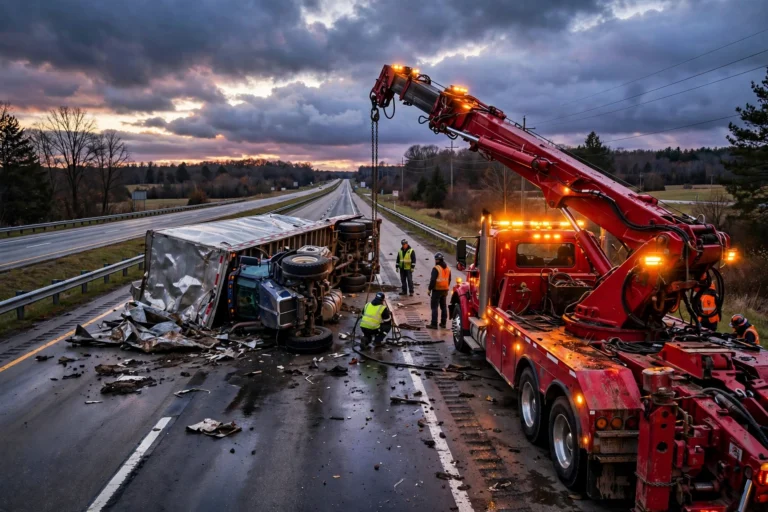
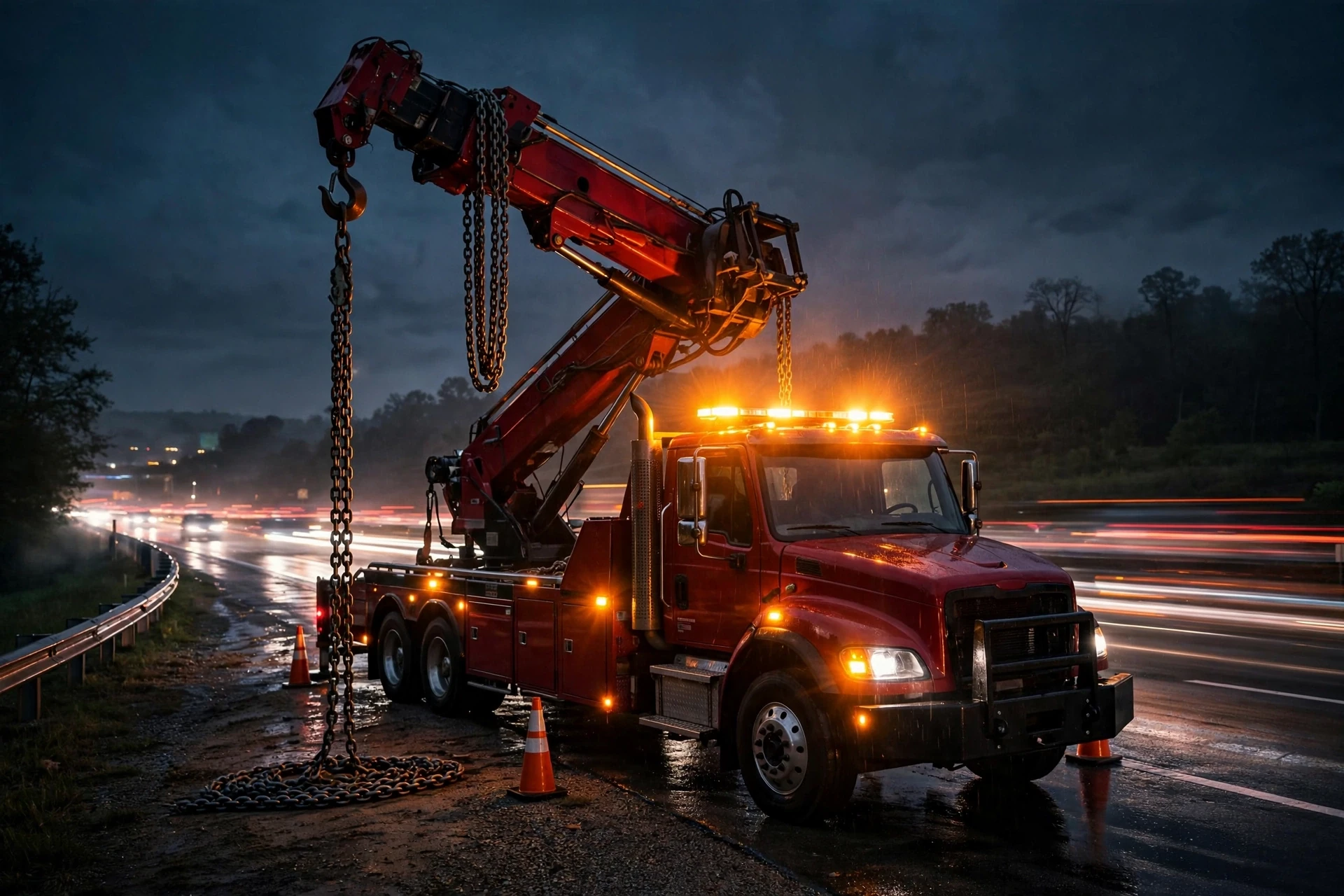
A rotator is a heavy-duty wrecker fitted with a rotating crane-like boom that can lift, swing, and set down enormous loads with precision. Unlike a standard wrecker’s straight-line winch pull, the boom rotates a full 360 degrees, so the operator can pick up a 40-ton trailer and place it exactly where it needs to go. Think of it as a tow truck crossed with a mobile crane.
The boom sits on a turntable behind the cab, powered by the truck’s hydraulics. Outriggers drop down on both sides to keep the whole rig stable while it lifts. A working rotator setup — truck, boom, rigging, and a trained operator — represents well over half a million dollars of equipment rolling to your breakdown.
What can a rotator do that a standard wrecker can’t?
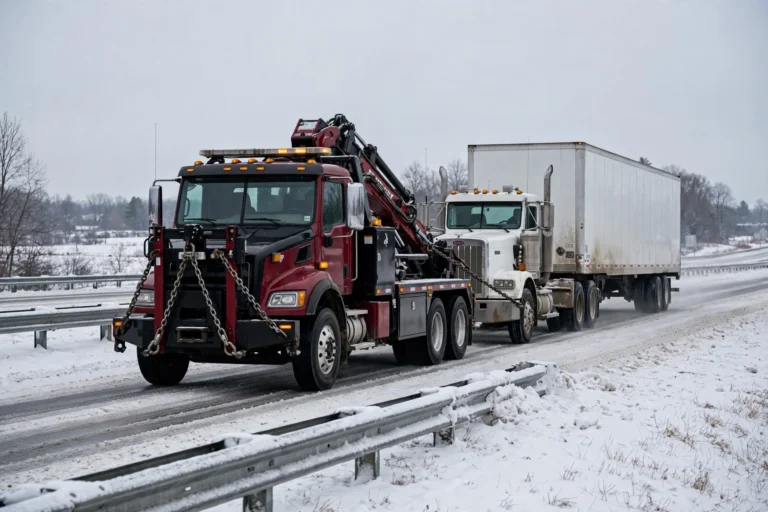
A standard heavy wrecker pulls in straight lines. That’s fine for towing a disabled tractor or dragging a stuck truck out of a ditch. But a rollover is a three-dimensional problem — the trailer is on its side, the load has shifted, and a straight pull would tear the trailer apart or spill the cargo across the highway.
A rotator solves that by lifting instead of dragging. It can pick a trailer straight up off its side, rotate it over the wrecker’s own outriggers, and set it back on its wheels — all while the freight stays inside. It can also lift one end of a loaded trailer while a second unit pulls, split a tractor from a trailer that’s folded into a jackknife, and reach over guardrails or down embankments where no truck can drive.
Rotator vs. standard heavy wrecker: what’s the difference?
Both are heavy-duty trucks, but they’re built for different jobs. Here’s the quick comparison:
| Standard heavy wrecker | Rotator | |
|---|---|---|
| Main tool | Winches + under-reach | Rotating crane boom |
| Motion | Straight-line pulls | Lifts, swings, sets down (360°) |
| Best for | Towing disabled rigs, simple winch-outs | Rollovers, jackknifes, complex recoveries |
| Crew | Usually 1 operator | Usually 2+ operators |
| Typical rate (reported) | $175–$250/hr port to port | $350–$600/hr |
Neither replaces the other. Most heavy calls start with a standard wrecker; the rotator rolls when the job outgrows straight-line pulling. A good dispatcher sends the right one the first time — which is why they ask so many questions on the phone.
When do you actually need a rotator?
You need a rotator when the vehicle can’t simply be pulled back onto the road. The classic cases:
- Rollover — tractor, trailer, or both on their side. This is the rotator’s home turf.
- Jackknife — tractor and trailer folded against each other, especially with a loaded trailer that can’t be straightened by pulling.
- Ditch or embankment extraction — the rig is somewhere a wrecker can’t get behind it to pull straight.
- Loaded-trailer recovery — the freight has to stay in the trailer. Lifting beats dragging every time cargo is involved.
- Under-bridge or tight-space recovery — the boom can reach over obstacles and work in spots with no room to maneuver.
If your truck just died on the shoulder and sits on its wheels, you don’t need a rotator — a standard heavy wrecker handles that for a lot less money.
How does a rotator recovery work, step by step?
It looks dramatic from the highway, but it’s a careful, methodical job:
- Scene size-up. The operator walks the wreck before touching anything — checking how the trailer lies, where the load sits, what’s leaking, and where the outriggers can plant. This is the most important five minutes of the job.
- Stabilize. Outriggers go down, the area gets coned off, and rigging straps or chains are placed at the engineered lift points — never just wrapped around whatever’s handy.
- The lift. The boom picks the trailer up slowly, often in stages, while a second line controls the swing. With a loaded trailer, the operator watches the load the whole way — a shifting load changes everything.
- The set-down. The trailer gets rotated upright and lowered onto its wheels (or onto a waiting flatbed/lowboy if it’s not roadworthy).
- Secure and document. Landing gear down, brakes checked, photos taken, and an itemized invoice written up for your carrier or insurer.
A straightforward uprighting can take under an hour. A loaded rollover in a ditch, at night, in bad weather? Plan on several.
How much does a rotator recovery cost?
Rotator work is usually billed hourly, and operators report regional ranges around $350–$600 per hour — roughly double a standard heavy wrecker, because you’re paying for a far more expensive machine and a bigger crew. Most companies also charge port to port, meaning the clock runs from when the truck leaves the yard until it gets back.
Rollover recoveries are the exception to simple hourly math: they’re usually quoted on scene, because no two are alike. A bobtail tipped on soft ground and a fully loaded 80,000-lb combination in a ravine are different jobs with different bills. Any reputable company will still give you the rate structure and a realistic range on the phone before rolling — if they won’t talk numbers at all, that’s a red flag. Out on I-69 through Fort Wayne, winter jackknife season is when rotators earn their keep, and honest operators quote the job before the truck moves.
Ranges above are operator-reported 2026 figures, not a tariff — always confirm your quote by phone before dispatch.
How do I know if my situation needs a rotator?
Use this quick test: is the vehicle on its wheels? If yes — even if it’s stuck, dead, or damaged — a standard heavy wrecker probably handles it. If it’s on its side, folded, or somewhere a truck can’t get behind it, you’re in rotator territory. See heavy duty towing in Fort Wayne.
Other tells: the dispatcher hears “rollover” or “jackknife” and immediately starts talking about a rotator. The trailer is loaded and the freight matters. Police or DOT are talking about closing lanes for an extended recovery. When in doubt, describe the scene honestly and let the dispatcher decide — sending the wrong truck wastes everyone’s time and your money.
What should I tell the dispatcher when I call?
The dispatcher is trying to send the right equipment the first time, so details matter. Have this ready:
- What happened — rollover, jackknife, stuck, breakdown, and whether the trailer is loaded or empty
- What it is — tractor only, straight truck, or full combination; roughly how heavy
- Where it lies — on its side? In a ditch? On the shoulder on its wheels?
- Exactly where you are — highway, mile marker or exit number, direction of travel
- Hazards — leaking fuel, damaged cargo, power lines down, traffic conditions
Five minutes of clear answers on the phone saves an hour of wrong-truck delays on the road. And always ask for the full quote — rate, minimums, and what’s billable — before the truck rolls.
Frequently asked questions
Both. A rotator is a fully capable heavy wrecker — it can tow a disabled tractor-trailer just like a standard heavy unit. Recovery is simply what it’s famous for. If a rotator is already on scene for a rollover, it’ll usually handle the tow afterward too.
It depends on the wreck. A simple uprighting of an empty trailer on flat ground can take under an hour. A loaded rollover in a ditch, at night, in bad weather can take three to five hours or more. The scene size-up and rigging take longer than the actual lift — rushing either one is how trailers get destroyed.
A proper rotator recovery is actually gentler than the alternatives. Lifting distributes force through engineered lift points; dragging a loaded trailer across pavement does not. Damage usually comes from the crash itself or from an under-equipped operator trying the job without the right tools — which is exactly why you want the rotator in the first place.
Because no two recoveries are alike. An hourly rate with a published structure is more honest than a flat fee that has to cover the worst case — you’d overpay on every simple job. What matters is that the company states the rate, the minimum, and the port-to-port policy clearly before dispatch, and hands you an itemized invoice after.
No — and that’s worth knowing. Rotators are rare, expensive machines run by specially trained operators. Many towing companies don’t own one and will call in a competitor’s rotator (adding a middleman to your bill) or attempt the job with standard wreckers. Ask directly: “Do you own the rotator, and is your operator certified on it?”
Need a rotator — or not sure if you do?
Describe the scene and get a straight answer plus a flat quote before anything rolls. One call, the right truck the first time. 24/7 heavy dispatch.
More on our heavy equipment: heavy duty towing · winch-out services · contact us